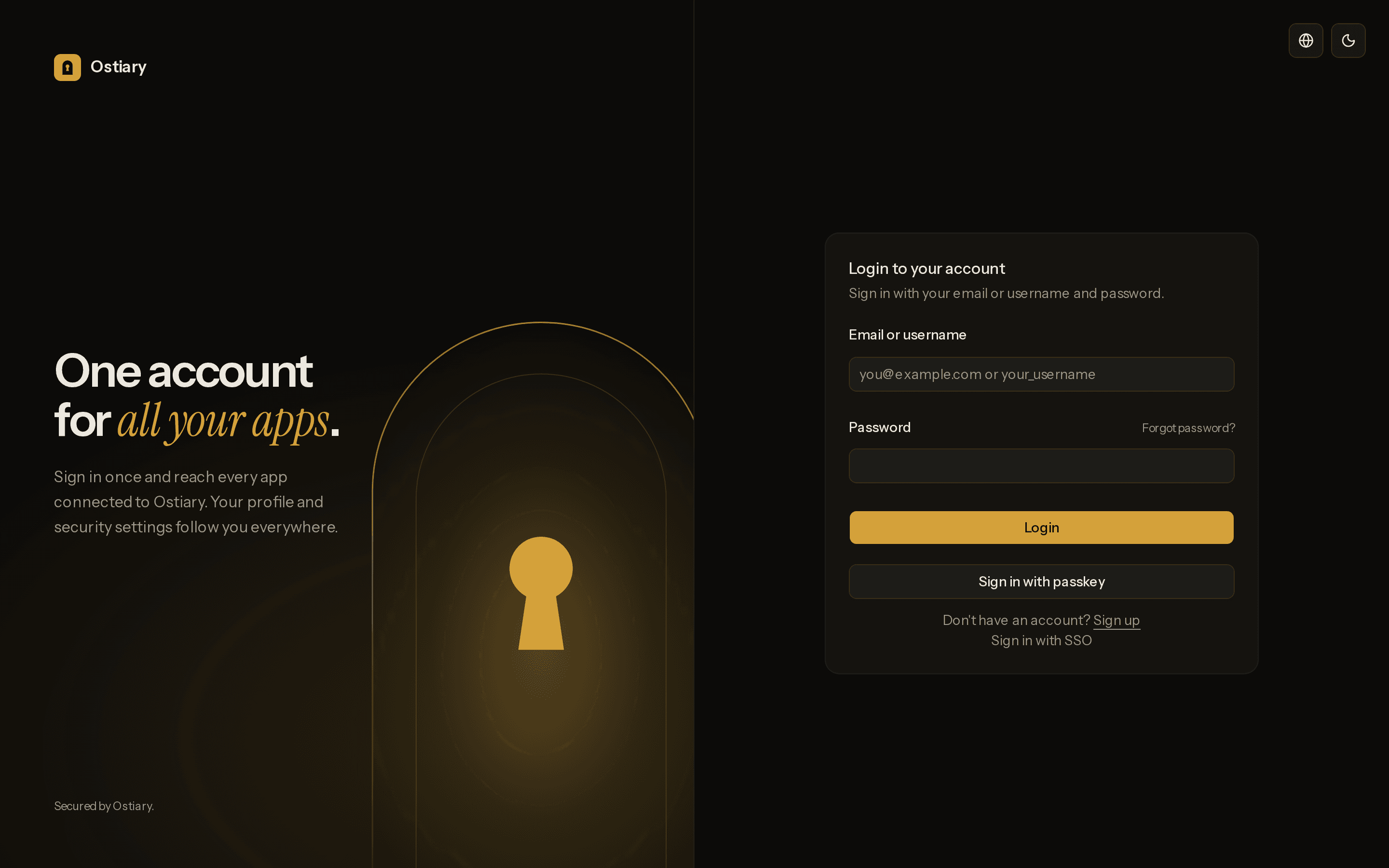
The front door for all your apps.
Ostiary is a self-hosted, open-source alternative to Auth0. One sign-in for every app you ship, with OpenID Connect, passkeys, two-factor, enterprise SSO and SCIM, and an admin console. Your users stay in your own Postgres.
Speaks the standards
- OpenID Connect
- OAuth 2.1
- PKCE
- WebAuthn
- TOTP
- JWT · JWKS
- DPoP
- Device flow
- Dynamic registration
- Client credentials
- SAML 2.0
- SCIM 2.0
- Standard Webhooks
Everything behind the door
The identity stack, without the invoice.
The building blocks you would rent from a hosted platform, as a Next.js app you deploy and own. No per-user pricing, no black box.
OpenID Connect provider
A complete OAuth 2.1 and OIDC server: discovery, PKCE, consent, refresh tokens, UserInfo, introspection and JWKS. Anything that speaks OIDC signs in with Ostiary.
Passkeys
Passwordless sign-in with WebAuthn, alongside email and password, one-time email codes, usernames and social sign-in.
Sign in with a passkey
Face, fingerprint or security key
Two-factor authentication
Authenticator apps and backup codes, required for admins, plus an optional captcha (Turnstile, hCaptcha, reCAPTCHA) on sign-up and sign-in.
Enter the code from your app
Or use a backup code
Enterprise SSO
Let companies sign in with their own SAML 2.0 or OIDC identity provider (Okta, Entra ID, Google Workspace…), once they prove the domain with a DNS record.
- acme.comSAMLVerified
- globex.ioOIDCVerified
- initech.devSAMLPending DNS
SCIM provisioning
Okta and Entra ID create, update and deactivate members of an organization. Leavers lose access at once.
- Oktaada@acme.comcreated
- Oktagrace@acme.comupdated
- Entra IDalan@globex.iodeactivated
Admin console
Search users, change roles, ban, revoke sessions and impersonate. Manage OAuth clients, organizations and SSO providers, with an audit log of every admin action.
Audit log
- user.banmallory@evil.test
- oauth_client.createBilling app
- sso_provider.verify_domainacme.com
Organizations
Teams with members, roles and email invitations, ready for B2B apps.
- ALAda L.Owner
- GHGrace H.Admin
- ATAlan T.Member
20 languages
Every screen and email translated, right-to-left included, in light and dark themes.
- English
- Français
- Deutsch
- Español
- 日本語
- 한국어
- العربية
- हिन्दी
- Português
- Polski
- Türkçe
- Svenska
- +8 more
Tokens for your APIs
Register your APIs and their scopes in the console. Choose which apps may call each one, token lifetimes, custom claims and DPoP-bound tokens.
// access token claims
aud https://api.example.com
scope orders:read orders:write
role admin
Device sign-in
CLIs, desktop apps and TVs show a short code; people approve it in the browser where they are already signed in.
$ acme login
Open auth.example.com/device
and enter WDJB-MJHT
✓ Signed in as ada@acme.com
Ready for AI agents
MCP clients and agents register themselves with Dynamic Client Registration or a client metadata document, when you turn it on. They stay limited to the scopes you allow, and people always see a consent screen.
client_name "Research agent"
redirect_uris ["http://127.0.0.1:33418/callback"]
token_endpoint_auth_method "none"
Several accounts
Stay signed in to work and personal accounts at once, and pick which one an app gets.
- ALada@acme.comActive
- ALada@personal.devSwitch
36 social sign-in providers
Google, Apple, Microsoft, GitHub and 32 more, each with its own logo on the sign-in and sign-up screens. Turn them on from the console, no redeploy, with Google One Tap. People link several to one account.
- Apple
- Microsoft
- GitHub
- GitLab
- Discord
- Slack
- X
- Twitch
- Notion
- Spotify
+24 more, from Figma and Zoom to Salesforce and Cognito
Webhooks
Your apps hear when users sign up, change, get banned or join an organization. Signed, retried, with a delivery log.
- user.created200
- organization.member.added200
- user.banned503 · retry in 5m
API keys
People and organizations create long-lived keys for scripts, limited to one of your APIs and its scopes. Your API checks them in one call.
valid true
scopes ["orders:read"]
Signing key rotation
Rotate the keys that sign tokens on a schedule or with one click. Old keys keep verifying for a grace period.
- kid 9f3c…Signing
- kid 41ab…Verifying · 30 days
Rate limits that hold
Sign-in, codes and emails are limited per address in Postgres, so the limits hold on serverless too.
POST /sign-in/email 429
Retry-After 42
Try again in 42 seconds.
Branding per app
Each app you register gets its logo, colors and headline on the sign-in screens. Your own mark always stays, so people know where they type their password.
Sign in to continue to
Acme Analytics
Export and deletion
People download everything you hold about them as JSON, or delete their account after an emailed confirmation. GDPR access, portability and erasure, built in.
my-data-2026-10-09.json
sessions, passkeys, apps included
secrets, tokens never
Connect an app
A few lines to sign in.
Ostiary is a standard OpenID Connect provider, so there is no SDK to learn. Use the OIDC library you already have.
- 01
Register your app
Create an OAuth client in the admin console and copy its ID and secret.
- 02
Point it at Ostiary
Give your OIDC library the issuer URL. Discovery handles the rest.
- 03
Ship
Users sign in once and move between your apps without a second password.
- Next.js
- Remix
- SvelteKit
- iOS & Android
- CLIs
- Your APIs
import NextAuth from "next-auth";

export const { handlers, auth, signIn, signOut } = NextAuth({
  providers: [
    {
      id: "ostiary",
      name: "Ostiary",
      type: "oidc",
      issuer: "https://auth.example.com/api/auth",
      clientId: process.env.OSTIARY_CLIENT_ID,
      clientSecret: process.env.OSTIARY_CLIENT_SECRET,
    },
  ],
});
Works the same with Better Auth's generic OAuth plugin, openid-client or AppAuth on mobile.
How it compares
Own it, or rent it.
An honest table. Ostiary fits when you want to own your identity layer. If you need a managed service with compliance certifications and an SLA, a hosted platform is the better choice.
| Capability | Ostiary | Auth0 |
|---|---|---|
| Where your users live | Your Postgres | The vendor's cloud |
| Pricing | Your hosting bill | Per monthly active user |
| Source code | Yours, MIT | Closed |
| OIDC and OAuth 2.1 provider | ||
| Passkeys, 36 social providers, organizations | ||
| Two-factor, email codes, captcha | ||
| Device flow and dynamic client registration | ||
| Enterprise SSO | OIDC and SAML | OIDC and SAML |
| SCIM provisioning, breached-password detection | ||
| Webhooks, API keys, signing key rotation | ||
| Branding per app, data export and account deletion | ||
| Admin console and audit log | ||
| Compliance certifications and SLA |
Deploy
Live in a few minutes.
Ostiary is a Vercel template. Bring a Resend account for email; everything else is provisioned for you.
- 01
Deploy
One click creates the project on Vercel with a Neon Postgres database.
- 02
Configure
Add a secret, your admin email and a Resend key. Migrations run during the build.
- 03
Sign up
Create your account. Your email becomes the first admin.
Or run it anywhere.
It's a pnpm monorepo of two Next.js apps and a shared core. Any Node host and any Postgres will do.
pnpm install
cp apps/auth/.env.example apps/auth/.env.local
pnpm db:migrate
pnpm dev:auth # http://localhost:3000Hold the keys.
Your own identity provider, deployed in minutes. MIT licensed, free to use, yours to change.